
What does ChatGPT say about your med spa?
When someone asks ChatGPT, Claude, or Perplexity to recommend a med spa, one name comes up. If it is not yours, you never hear about the customer you lost. AIOInsights shows you what AI systems can access, understand, and verify about your spa, and what to fix, free.
Run My Free CheckTranscript
What does ChatGPT say about your med spa? Your customers are asking AI about you, and you have no idea what it says. It could be naming another spa instead of you. So Digilu built AIOInsights, a free tool that shows exactly how AI like ChatGPT, Claude, and Perplexity sees your spa. Enter your site, and in seconds see your AI visibility score and what to fix, free. Check yours free at AIOInsights.com. So, what does AI say about your spa?
What an AI needs to find on your site
Across the common med spa questions, the same short list keeps coming back. Each item has to be text on a page, not an image, a booking widget or a PDF.
Who is responsible
A named medical director with degree, license number and state, linked to the board's lookup, and the legal entity that provides medical services under your brand.
Who does the work
A page per injector: full name, license type, license number, the treatments they perform, and who supervises them.
What goes in the syringe
A treatment menu that names the actual brands and devices you use, with FDA wording that matches what the FDA decided.
What it costs
Prices with the unit, the product, what changes the total, and the month you last checked them.
What results look like, honestly
Before and after photos with the procedure named and the statement that results vary, written as captions rather than baked into the image.
The referral now happens inside the AI
- Customers ask AI first. Before they ever call, people ask ChatGPT or Perplexity for a med spa in their area and their situation. The AI answers with a short list, or a single name.
- AI recommends what it can verify. It names the spa whose services, credentials, reviews, and trust signals it can clearly read and confirm. Ambiguity loses.
- If your site is unclear, another spa gets named. Not because they are better, but because the AI could understand them and could not understand you.
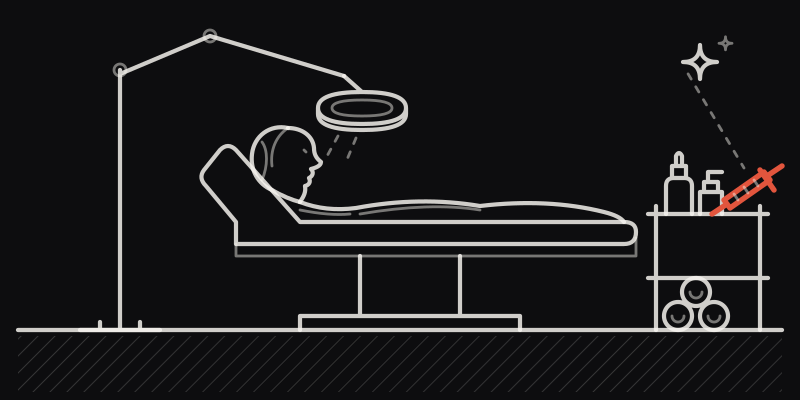
What is at stake for a med spa
A med spa is not a restaurant. The question a patient brings to an AI assistant is rarely just "who is nearby". It is "who is qualified to put a needle in my face", "is the product real", and "what will this cost me". Those questions have become sharper for good reason. In 2024 the FDA warned that a counterfeit version of Botox had been found in multiple states, with harmful reactions after injections given by licensed and unlicensed people, some in non-medical settings. After a warning like that, "is this med spa legit" is a safety question, not a vanity one.
An AI assistant can only answer it with what it finds in public. If your practice has published who your medical director is, which licenses your injectors hold, which products you use and what they cost, the answer about you can be specific and correct. If you have published a mood board and a booking button, the answer is either vague or built from someone else's page.
Why med spas are hard for machines to read
Several things that are normal in aesthetics make a practice unusually easy to misdescribe.
- It is medicine that looks like a spa. The California Medical Board says plainly that using prescriptive drugs and devices for cosmetic reasons "is the practice of medicine", in its guide The Business of Medicine: Medical Spas. Yet many practices list themselves as day spas, and the vocabulary most websites use for structured data, schema.org, has no med spa type at all. A practice can describe itself as a beauty business in three places without meaning to.
- The name on the door is often not the legal owner. Where the law requires physicians to own the medical practice, a brand, a management company and a physician corporation can each appear in public records under a different name.
- The most important facts live on regulated words. BOTOX is one company's trademark. "FDA-cleared" and "FDA-approved" are different FDA decisions. Compounded semaglutide is not FDA-approved. Used loosely, each of these words tells a machine something false.
- The evidence is locked away. License boards sit behind search forms, manufacturer locators render with script, and prices hide in images and booking widgets. A person can dig. A crawler mostly cannot.
What AIO means for a med spa
AIO, AI optimization, is the work of making a business readable, checkable and consistent to the AI systems that now answer questions about it. For most businesses that means clear services, a consistent name and address, and honest reviews. For a med spa it means one more thing, and it is the thing that matters most: stating the medical facts behind the practice in plain text, in a form a stranger can verify.
Those systems do read the open web. OpenAI says ChatGPT search can include public sites that do not block its search crawler, in its publisher FAQ. Google says its AI features draw on indexed pages across many sources. Yelp has announced that its reviews, ratings, photos and business details appear inside ChatGPT. So your site, your listings and your review record are all inputs. None of these companies publishes how it chooses one med spa over another, and anyone who promises you a placement is promising something they do not control.
What you can control is whether the facts about you are there, are true, and agree with each other. That is what the six AIOInsights pillars measure, and for a med spa three of them do most of the work: semantic clarity, whether your pages say plainly what you are and what you offer; authority, whether the credentials behind the practice are stated and checkable; and reputation signals, whether your reviews and replies are clean evidence. Entity consistency and local presence matter more than usual when a brand and a legal owner differ, and AI discoverability covers whether the systems can reach your pages at all.
A map of the questions
The twelve pages below each take one question and answer it in depth, with the sources it rests on. They fall into four groups.
Identity: what kind of business are you, and who stands behind it. Start with the Google category, then your medical director, your injectors, and the harder case of a brand that is not the legal owner.
Claims: the words an AI will quote. Botox or neurotoxin, FDA-cleared or FDA-approved, prices, before and after photos and semaglutide. Each is a place where a loose word becomes a false statement once a machine repeats it.
Reputation: what patients say, and what you say back. The FTC fake reviews rule and replying to reviews without breaking HIPAA.
Limits: what none of this can do. Where AIO falls short for med spas is the page we would read first if we were deciding whether to spend time on any of it.
Questions med spa owners ask about AI
Each page answers one question for a medically supervised aesthetics practice, with the sources it rests on.
- Should a med spa choose "Medical spa" or "Day spa" as its Google category?
- How does naming your medical director help AI verify a med spa?
- What should a med spa publish about each injector so AI can confirm who they are?
- When the brand on the door is not the legal owner, how does AI get your med spa wrong?
- "Botox" or "neurotoxin": why the brand name decides what AI thinks your med spa offers
- FDA-cleared or FDA-approved: which words can a med spa use for its lasers and fillers?
- Should a med spa publish prices, and how should they be written so AI quotes them correctly?
- What the FTC fake reviews rule means for med spa review programs, and for what AI summarizes
- How can a med spa reply to reviews without breaking HIPAA?
- Before and after photos: what a med spa must say next to them, and what AI drops
- How should a med spa describe semaglutide so AI does not repeat a claim the FDA calls misleading?
- Where AIO falls short for med spas
What we have not measured
We have not run a measured set of ChatGPT, Gemini or Perplexity prompts for med spas, so this guide does not tell you what those assistants currently say about any practice, and it does not claim that any single change moves an answer. We do not know whether AI assistants read RealSelf, the manufacturer locators or state license boards when answering med spa questions; we found no evidence either way. Where a page in this guide rests on a vendor blog or a secondary legal summary rather than a regulator or the platform itself, it says so.
None of this is medical or legal advice. It describes how AI systems read a med spa in public. The rules that bind your practice come from your state board, and the reading of them belongs to your own counsel.
See what AI can read about your spa
Run the free check on your website. Your URL is all it takes, and your AI visibility score lands in about 15 seconds.
Run My Free CheckWant Digilu to manage this for you? See how Digilu manages this for med spas →