
FortClips: A Live Visibility Architecture Example
FortClips is a live example of how a focused content property can be structured for clearer discovery. It is not presented as a proven traffic case study. It is presented as an example of visibility architecture in progress.
FortClips is a live visibility architecture example, not a finished success case. The value of this example is the structure and reasoning, not a claim of final results.
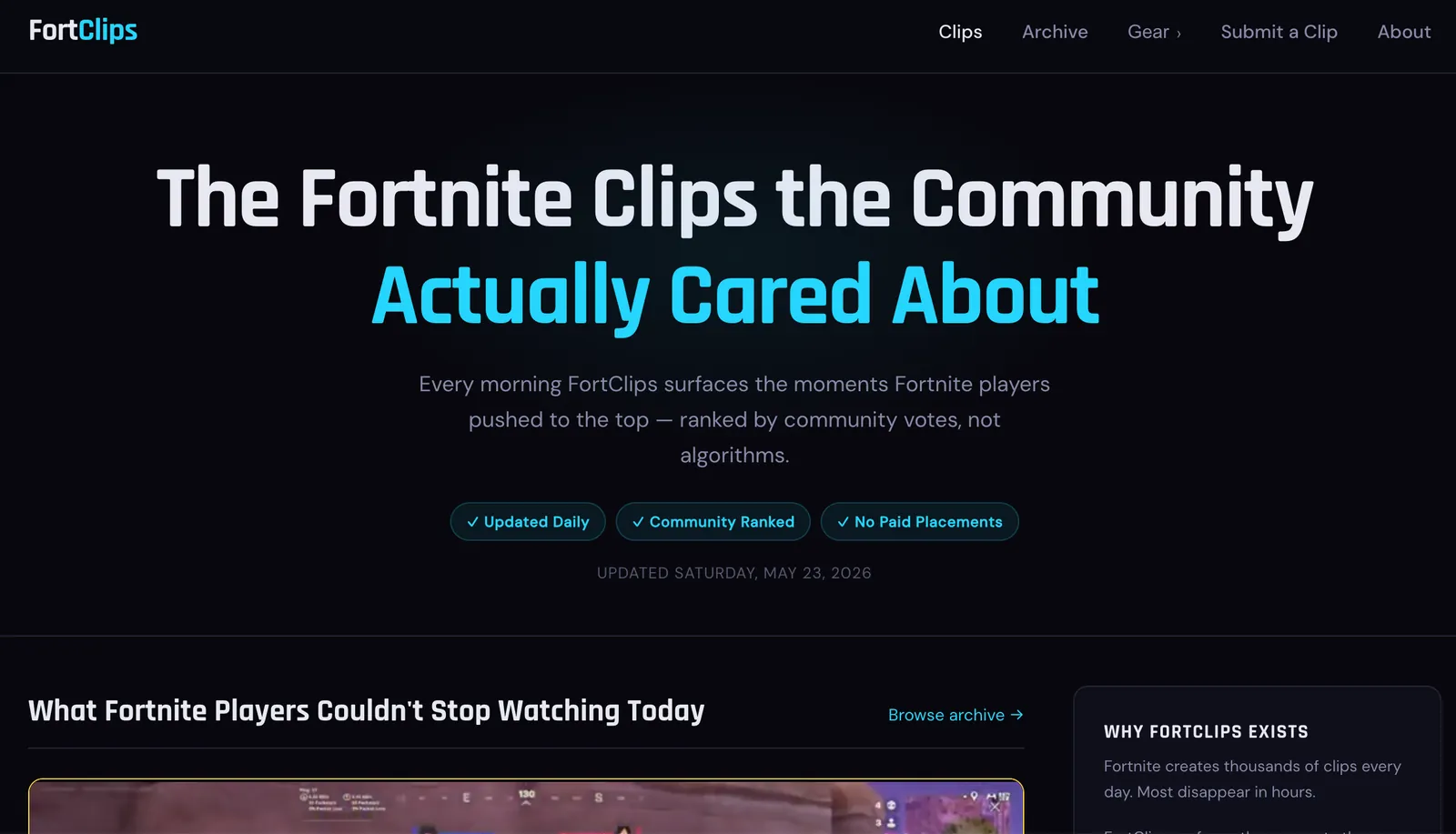
What FortClips Is
FortClips is a Fortnite clip discovery site built around a simple category promise: surfacing the Fortnite clips the community actually cared about. The project is useful as a visibility architecture example because it has a focused topic, repeatable content structure, archive potential, and AI-readable organization. It demonstrates how the principles behind trust visibility: clarity, consistency, authority signals, and structured presence: apply to a content property, not just a business website.
The site focuses on a single game, a single type of content, and a single audience. That specificity is intentional. Broad gaming sites that cover every game, every platform, and every topic dilute their topical identity. FortClips commits to a narrow category and maintains that commitment across its structure, metadata, navigation, and content.
Why This Example Matters
AIOInsights evaluates whether a website creates enough clarity, consistency, and trust for modern discovery systems. FortClips demonstrates how those principles can be applied to a focused content property: not a local business, not a professional services firm, but a community-driven content site with its own visibility challenges.
The principles are the same. A discovery system evaluating FortClips asks the same structural questions it asks about any website: What is this? Who does it serve? What does it contain? Is the information consistent? Can I trust what I find here? Is it organized in a way I can navigate and interpret? Clear answers to these questions improve confidence. Ambiguous answers reduce it.
What This Example Does Not Claim
This example does not claim that FortClips has achieved:
- Ranking success in Google or Bing search results
- AI recommendation success in ChatGPT, Perplexity, or other AI search platforms
- Traffic growth above baseline expectations
- Revenue growth or monetization success
- Authority in the Fortnite content space
It shows structure, not outcome. Results require time, indexing, consistency, and measurement. This example demonstrates the architectural decisions that support discoverability: not a report on what those decisions have produced.
Trust Visibility Principles Demonstrated
Each of the following principles reflects a dimension of trust visibility as evaluated by AIOInsights. FortClips illustrates how these dimensions apply in a content property context.
These eight principles are not gaming-specific: they are the same structural decisions that make any website easier for discovery systems to read, interpret, and recommend with confidence.
Semantic Clarity
FortClips has a narrow topical identity centered on Fortnite clips. That clarity reduces ambiguity and makes the site easier to understand than a broad gaming site covering every game, platform, and topic. Semantic clarity is not about being small: it is about being legible. A site that knows what it is and communicates that consistently across every page is more interpretable than one that covers everything and commits to nothing.
The narrower the topical scope, the easier it is to maintain semantic consistency. A Fortnite clip site does not need to explain what Fortnite is every time it appears: the context is established by the site's category, name, and content pattern. That established context accumulates into a strong semantic signal over time.
Archive Depth
Daily, weekly, category, tag, and creator archives can help a content property become more understandable over time. Archive depth should not just create more pages: it should create clearer relationships between topics, creators, clips, and recurring categories. A site with well-structured archives communicates not just what it contains, but how those contents relate to each other.
For FortClips, archive depth means a crawler or AI system can navigate from a creator's most recent clip to their archive, from a category archive to individual clips, and from a daily archive to the week and month it belongs to. These navigable relationships form an interpretable content map: which is something broad, unstructured content sites rarely have.
AI-Readable Structure
AI-readable structure includes elements that reduce ambiguity for systems that interpret and index content. For FortClips, the key structural elements are:
- sitemap.xml: provides a comprehensive list of indexable pages, helping crawlers discover the full scope of the site's content without relying on internal link discovery alone.
- robots.txt: clarifies which pages and directories should and should not be crawled, reducing wasted crawl budget on non-content pages.
- llms.txt: provides a plain-language summary of the site's purpose, content categories, and organizational structure for AI systems that consult it.
- Clear navigation: consistent, logical navigation that mirrors the site's topical organization and helps both visitors and crawlers understand the site's hierarchy.
- Consistent summaries: clip descriptions and metadata that use consistent category language rather than varying or templated placeholder text.
- Structured page hierarchy: a clear relationship between homepage, category pages, archive pages, and individual clip pages.
None of these elements guarantee inclusion in any AI system's recommendations. They can help reduce ambiguity, support better indexing, and improve the clarity of the signal a site sends to systems that encounter it. The distinction between "can help" and "guarantees" is the difference between honest architecture and overclaimed outcomes.
Why It Is a Live Experiment
FortClips will become more valuable as content compounds, creator references accumulate, clip tags mature, and recap pages build topic history. Visibility architecture does not produce immediate results. It creates the structural conditions under which discoverability can develop over time.
A site that is one month old and structurally excellent is better positioned than a site that is two years old and structurally poor: but it has not yet had the time to demonstrate that advantage through measurable outcomes. This is why the example is called a live experiment rather than a case study. The structure can be observed now. The results require time.
Visibility architecture can be evaluated before long-term performance is available. Structure should be built before outcomes are measured. Waiting for results to evaluate structure means starting behind.
What AIOInsights Would Monitor
If AIOInsights were applying its full evaluation framework to FortClips over time, the dimensions to monitor would include:
Architecture signals
These dimensions can be assessed from the site's current structure, independently of how long it has been live.
Accumulation signals
These dimensions require ongoing publication and indexing before they produce meaningful data.
These dimensions would not all show meaningful data immediately. Some: like topical repetition and archive clarity: can be evaluated structurally from day one. Others: like indexable page growth and repeat visibility signals: require time and ongoing publication to become measurable.
What Businesses Can Learn From It
Even though FortClips is a gaming example, the visibility principles apply to local businesses, service companies, franchises, and brands. Clear categories, consistent identity, structured proof, and repeated authority signals make a business easier to understand: whether that business is a Fortnite clip site or an Atlanta accounting firm.
The structural questions are the same: What is this? Who does it serve? What does it contain or do? Is the information consistent? Can I trust what I find? Is it organized in a way I can navigate? A local dentist, a regional law firm, and a Fortnite clip site all benefit from honest, clear, consistent answers to those questions across every public-facing surface.
The lesson is not that gaming sites and professional services firms should look the same. The lesson is that visibility architecture is a discipline that applies across categories: and the businesses and content properties that invest in it early accumulate an advantage that is hard for later arrivals to close.
AIOInsights and Digilu
AIOInsights identifies trust visibility opportunities across semantic clarity, entity consistency, authority, AI discoverability, trust, and local presence. The FortClips example is one illustration of how those principles manifest in a live content property.
Digilu helps businesses and content properties turn those opportunities into stronger brand, website, content, reputation, and AI discoverability systems. The full Trust Visibility Evaluation: conducted by Digilu strategists: provides the comprehensive picture and prioritized strategy that goes beyond what the free evaluation can identify.
No. FortClips is presented as a live visibility architecture example, not a finished success case. It demonstrates structure, reasoning, and implementation: not a claim of measured results. Traffic results, ranking positions, and AI recommendation frequency require time and ongoing measurement.
Gaming clip sites require clear topical focus, repeatable content structure, archive organization, creator references, and fast discoverability. Those same principles apply to many business websites and content properties. The structural questions a discovery system asks of FortClips are the same ones it asks of a local dental practice or a regional law firm.
No. llms.txt does not guarantee AI visibility. It can help provide clear site context for systems that choose to read it. The goal is reduced ambiguity and improved interpretability: not guaranteed inclusion in any AI system's responses or recommendations.
AIOInsights evaluates the structure, clarity, semantic consistency, archive potential, and AI-readable organization of the site: not traffic outcomes or ranking positions. The evaluation framework assesses what can be observed structurally, independently of performance metrics that require time to accumulate.
Yes. Local businesses also benefit from clear categories, consistent entity signals, structured proof, review infrastructure, and crawlable authority content. The structural principles that support discoverability are consistent across property types: a Fortnite clip site and a regional HVAC company face the same fundamental question: am I clear, consistent, and credible enough for discovery systems to confidently understand and recommend me?
Traffic results matter, but visibility architecture can be evaluated before long-term performance is available. Structure should be built before outcomes are measured. Waiting for results to evaluate structure means starting behind: because the businesses and content properties that build strong visibility architecture early accumulate an advantage that later arrivals have to work harder to close.